The Rise of AI Life Managers – How AI Assistants Could Soon Run Your Entire Life – Would You Rather?
May 19, 2026 · Rich Benvin
The Rise of AI Life Managers
How AI Assistants Could Soon Run Your Entire Life
For years, technology helped humans access information faster.
Now it is beginning to make decisions for us.
The next major evolution of artificial intelligence may not simply be smarter chatbots, image generators, or search engines. It may be something far bigger:
AI systems that organize, optimize, automate, and manage nearly every aspect of human life.
Welcome to the era of the AI Life Manager.
These systems are rapidly evolving from passive tools into active digital agents capable of handling scheduling, communication, shopping, planning, reminders, finances, workflows, productivity, entertainment, health tracking, and even emotional support.
In the near future, many people may wake up each morning with an AI system already optimizing their day before they even touch their phones.
And the question is no longer whether this transformation is coming.
The question is whether humans are ready for it.
From Search Engines to Digital Operators
The internet originally functioned like a giant library.
Humans searched for information manually.
Then came smartphones, apps, social media, cloud computing, and recommendation algorithms. Technology became more personalized, predictive, and integrated into everyday life.
But AI Life Managers represent something fundamentally different.
They are not merely tools you use.
They are systems that begin acting on your behalf.
Instead of asking:
- “What should I do today?”
AI may soon tell you:
- which meetings matter
- what tasks to prioritize
- when to rest
- what to eat
- what to buy
- which opportunities deserve attention
- which subscriptions to cancel
- how to optimize your finances
- when your stress levels are too high
- who you should reconnect with
- which habits are sabotaging your goals
In other words:
AI is evolving from assistant…
to operator.
Your Future AI Life Manager
Imagine waking up tomorrow and your AI system says:
“Good morning. Your sleep quality was below average due to elevated stress levels. I moved your non-essential meetings to tomorrow, reordered groceries based on your nutrition goals, paid your utility bill, summarized overnight news relevant to your investments, scheduled a workout during your highest energy window, and drafted replies to your most important emails.”
This sounds futuristic.
But pieces of this already exist.
AI tools can currently:
- schedule meetings
- automate workflows
- summarize documents
- organize calendars
- manage tasks
- analyze spending
- generate shopping lists
- optimize travel
- track biometrics
- answer emails
- create content
- monitor goals
- recommend habits
The missing piece is integration.
The next generation of AI systems will connect all these functions together into one continuous digital operating layer.
The Rise of Autonomous Digital Agents
The biggest shift may come from autonomous AI agents.
Unlike traditional software that waits for commands, AI agents can:
- observe
- analyze
- decide
- act
- adapt
This changes everything.
Instead of opening 15 apps every day, humans may increasingly interact with a single AI interface managing those systems behind the scenes.
Your AI Life Manager could eventually:
- negotiate bills
- compare insurance
- book vacations
- coordinate schedules
- optimize taxes
- filter notifications
- organize files
- manage investments
- monitor cybersecurity threats
- handle customer support interactions
- manage smart homes
- optimize productivity cycles
- coach behavior patterns
In many ways, AI Life Managers could become:
personal CEOs for human life.
The Death of Digital Overload
Modern life is becoming cognitively overwhelming.
Most people now manage:
- hundreds of passwords
- thousands of files
- dozens of apps
- endless notifications
- fragmented workflows
- social media feeds
- subscriptions
- AI tools
- financial platforms
- communication channels
Humans were never designed to process this much information continuously.
The result is:
- stress
- burnout
- distraction
- digital fatigue
- reduced attention spans
- decision exhaustion
AI Life Managers may emerge partly as a survival mechanism against digital overload.
Instead of humans adapting to increasingly complex technology…
AI may adapt technology around humans.
AI Will Know You Better Than You Know Yourself
One of the most fascinating — and unsettling — aspects of AI Life Managers is personalization.
Your AI may eventually understand:
- your habits
- moods
- weaknesses
- ambitions
- spending patterns
- health signals
- emotional triggers
- productivity cycles
- relationship patterns
- attention span
- personality traits
Over time, it may recognize behavioral patterns humans cannot see themselves.
Your AI might know:
- when you are likely to procrastinate
- when you are emotionally vulnerable
- when you make poor financial decisions
- when you are heading toward burnout
- when your focus is strongest
- which environments improve performance
- which people positively or negatively affect your mindset
In many ways, the AI Life Manager becomes:
a mirror of the self.
The Psychology of Outsourcing Life
There is another side to this revolution.
Convenience always comes with tradeoffs.
As AI systems become more capable, humans may begin outsourcing:
- memory
- organization
- decision-making
- navigation
- creativity
- social interactions
- critical thinking
This raises profound philosophical questions.
If AI handles:
- planning
- remembering
- optimizing
- deciding
- recommending
then what remains uniquely human?
The danger is not simply technological dependence.
It may be psychological dependence.
Humans could slowly lose the ability to:
- tolerate boredom
- focus deeply
- think independently
- solve problems manually
- remember information naturally
- trust intuition
The more friction AI removes from life…
the less resilient humans may become.
The New Digital Divide
The future may also create a new type of inequality.
Not between people who have internet access and those who do not.
But between:
- humans augmented by powerful AI systems
- and humans navigating life manually
AI-enhanced individuals could potentially:
- learn faster
- automate income
- optimize health
- scale businesses
- manage time better
- process information more efficiently
- outperform traditional workflows
The AI Life Manager could become the ultimate productivity multiplier.
And this may dramatically reshape:
- education
- careers
- entrepreneurship
- relationships
- wealth creation
The Business Opportunity Is Massive
The AI Life Manager industry could become one of the largest technology sectors of the next decade.
Potential markets include:
- AI productivity
- digital wellness
- workflow automation
- smart assistants
- AI healthcare coordination
- AI finance optimization
- personal AI agents
- memory augmentation
- AI operating systems
- AI life coaching
Major technology companies are already racing toward this future.
The companies that successfully integrate:
- AI
- memory
- personalization
- automation
- workflow orchestration
could become the next generation of dominant platforms.
AI Life Managers and Human Identity
Perhaps the deepest question is this:
If AI begins optimizing every aspect of life, do humans become more free… or less human?
There is a paradox emerging.
AI promises:
- convenience
- efficiency
- optimization
- personalization
- productivity
But humans do not always grow through efficiency.
Sometimes growth comes through:
- struggle
- uncertainty
- mistakes
- exploration
- randomness
- boredom
- discomfort
If AI removes too much friction from life, humanity could risk losing the experiences that build wisdom, creativity, resilience, and individuality.
The future may require balance.
Not rejecting AI.
But learning how to use it without surrendering human agency entirely.
The Future Human
The next generation of humans may become deeply AI-augmented.
People may eventually rely on AI systems for:
- thinking
- organizing
- learning
- remembering
- planning
- creating
- communicating
- decision support
AI Life Managers could become as common as smartphones are today.
Invisible.
Always present.
Always listening.
Always optimizing.
The real challenge will not simply be building these systems.
It will be deciding:
- how much control humans are willing to surrender
- how much autonomy AI should have
- and what kind of future humanity actually wants
Because once AI becomes deeply embedded into everyday life…
there may be no going back.
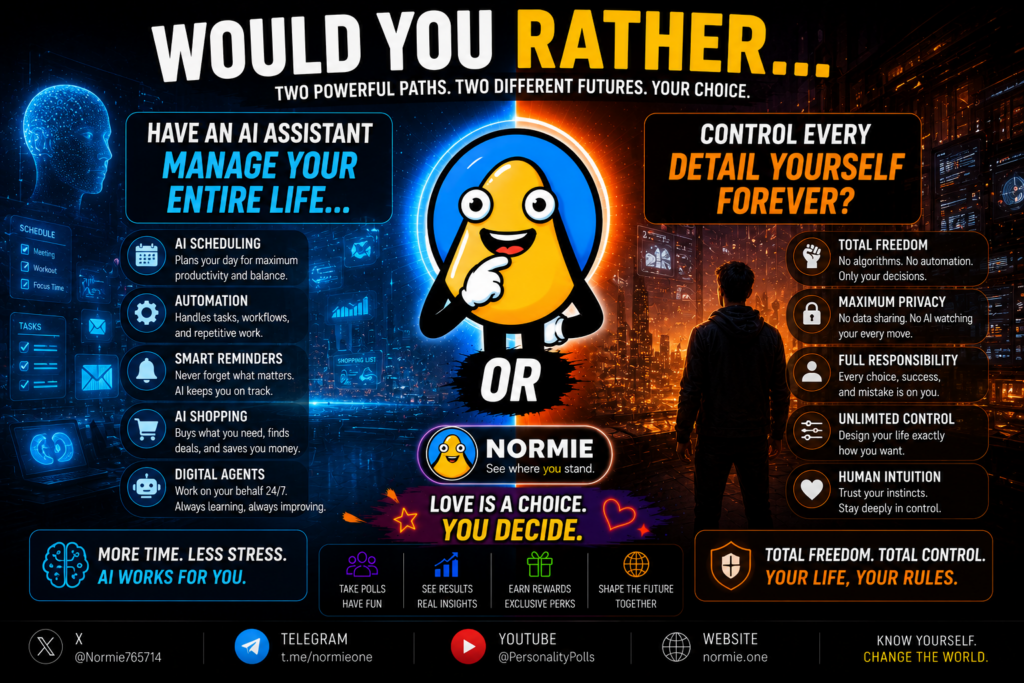
Would You Rather…
Have an AI assistant manage your entire life…
OR
Control every detail yourself forever?
This question may sound hypothetical today.
But sooner than most people realize…
it could become one of the defining psychological choices of the AI era.
Visit NORMIE at https://normie.one/
Explore more: